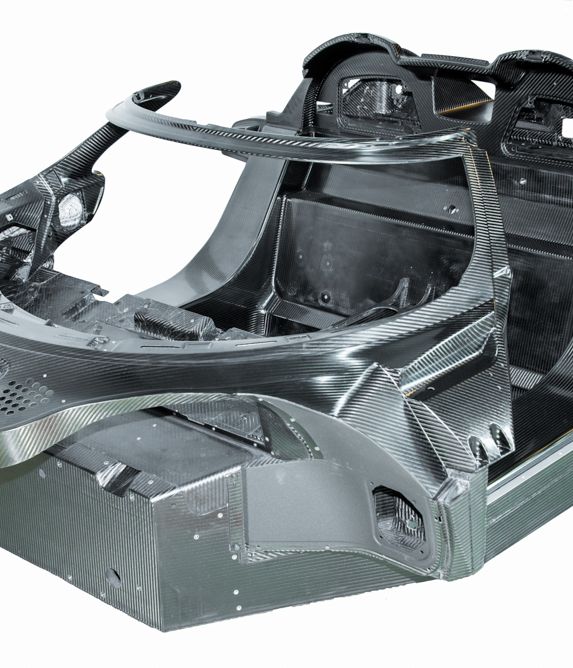
AT THE CORE OF EVERY KOENIGSEGG CAR IS ITS CARBON FIBER TUB CHASSIS.
The Koenigsegg chassis is a case of do-it-once-do-it-properly, with key elements of the chassis we use today still true to Christian von Koenigsegg’s original design.
The Koenigsegg chassis is a pre-impregnated carbon fiber construction with an aluminium honeycomb core structure (the same as used in Formula 1) for increased crash protection. The aluminium fuel tank is integrated into the tub chassis, inside the hollow box sections across the rear and along the right and left sills. This gives the fuel tank maximum protection and allows for the best possible weight distribution in combination with the most optimal packaging.
The Koenigsegg carbon fiber tub chassis has 65,000 Nm per degree of torsional rigidity, more than any other vehicle in the world, current or past, which is astonishing as the car also is a roadster, with a detachable and stowable roof panel. What does such a measurement mean in the real world?
In simple terms, it means that the car is very, very resistant to twisting or flexing when under pressure (e.g. at 2 g’s in a corner).
THE CORE
MORE ON THE
CHASSIS
A stiff chassis allows for softer suspension and a more comfortable ride compared to a less stiff chassis. It gives you greater control because the suspension doesn’t have to be tuned to compensate for chassis flex.
With a stiffer chassis, our suspension engineers can focus more on vehicle dynamics, controlling the ride and response of the car, and less on compensating for relatively poor chassis resonance